
Why AI Won’t Replace Stationery Designers
But It Will Raise the Standard
Let’s talk about AI.
Because whether we like it or not, it’s already here, designing invitation layouts in seconds, offering infinite variations, and quietly lurking in the background of every creative industry conversation.
If you’re a stationery designer, particularly one working in weddings or print, you’ve probably had a moment of thinking: Right then… should I be worried?
Short answer: no.
More accurate answer: AI isn’t replacing stationery designers. It’s raising the baseline.
And that changes where value really sits.
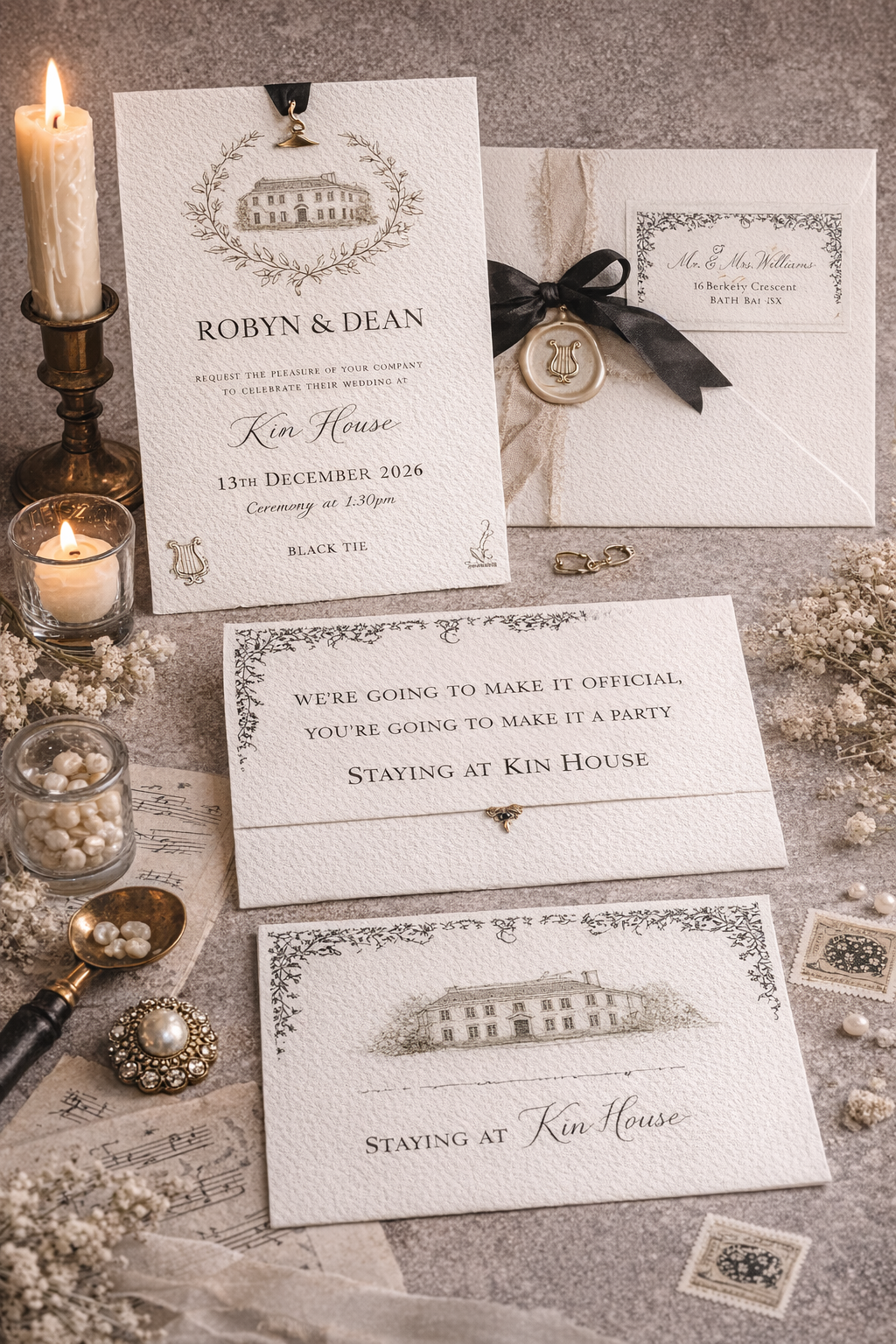
AI-generated image of an invitation suite in response to a client brief
Anyone Can Generate a Visual. Not Everyone Can Design.
AI can now generate a wedding invitation layout almost instantly. That ship has sailed. It’s no longer impressive, it’s just… a thing that exists.
But generating a visual is not the same as designing a piece of stationery.
Design is about hierarchy, spacing, proportion and clarity. It’s about knowing what matters most, what needs breathing room, and how information should flow when someone actually holds the piece in their hands.
AI can produce something that looks polished on screen.
It cannot tell you whether it works.
It doesn’t understand how ink behaves on textured stock, how spacing shifts once a piece is trimmed, or why something that looks fine digitally suddenly feels cramped in real life.
Those decisions don’t come from prompts. They come from experience.
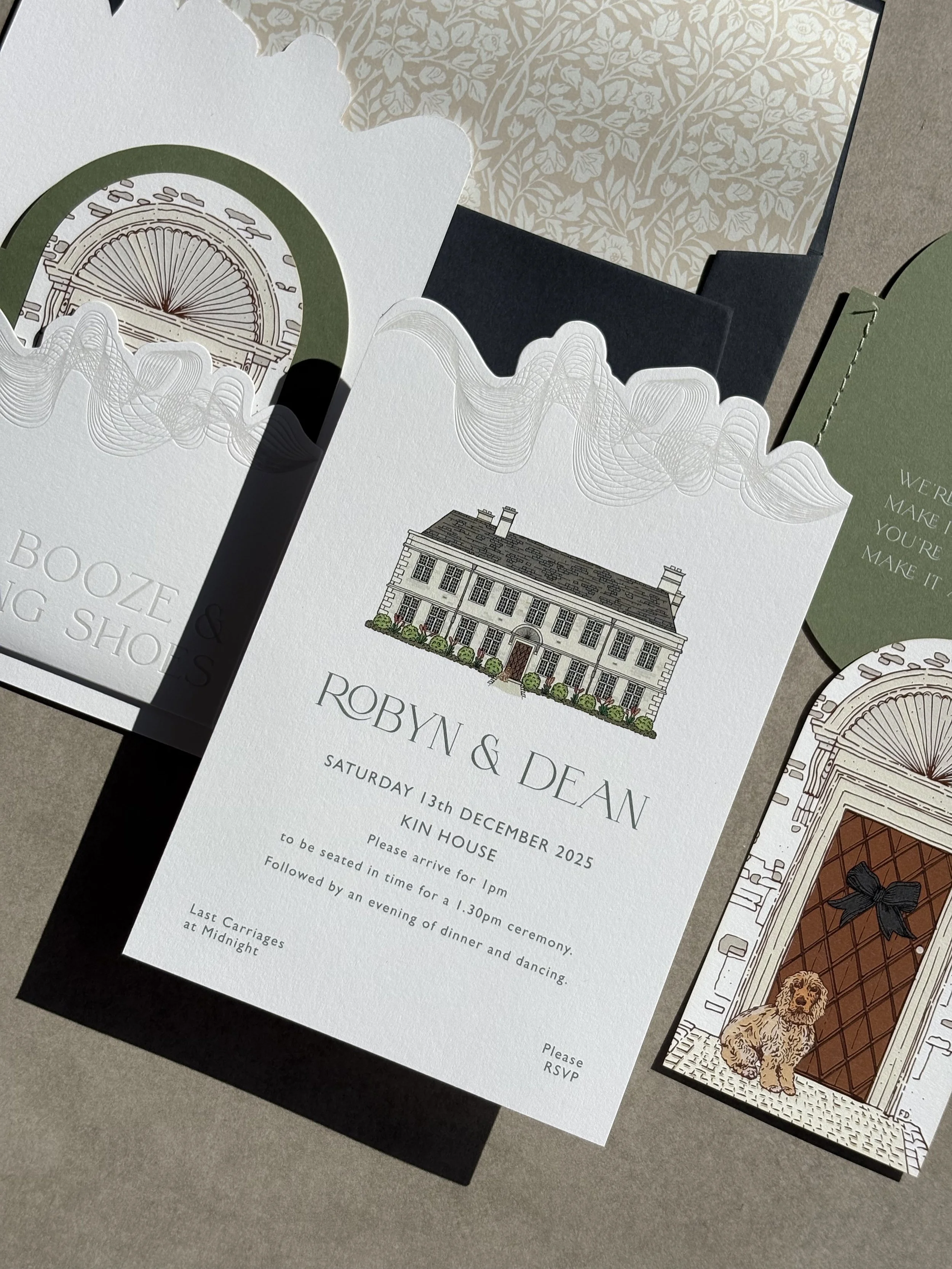
Designer’s invitation suite in response to the same brief
Where AI Stops, Professional Skill Steps In
There are some very clear limits to what AI can do in the world of serious stationery design.
AI cannot:
Prepare consistently reliable, print-ready artwork
Pick up the phone to a printer when something needs fixing
Handle last minute text changes without everything unraveling
Pair paper, ink and print method with intention rather than guesswork
Design for real venues, real timelines and real people
And crucially, it cannot develop taste.
Taste is learned slowly. It’s shaped by client conversations, by weddings that evolve, by moments where you realise why something didn’t quite land. It’s contextual, instinctive and very human.
That’s why AI does not have style.
And why it can’t replace what you bring to the table.
The Real Shift: From Access to Authority
For a long time, access was the barrier. Professional design software felt intimidating, expensive or unnecessary. Plenty of designers built businesses using limited tools because clients didn’t know what they were missing.
AI lowers that barrier even further. Anyone can now produce something that looks “nice”.
But “nice” has never been the goal.
What AI doesn’t remove is the need for authority.
And authority comes from understanding what you’re doing, not just pressing the right buttons.
Being able to move confidently from concept to artwork, and from artwork to print, is where professional designers still stand apart.
Professional Design Software Still Matters (And Yes, Adobe Comes Up a Lot)
Professional graphic design software exists for one main reason: control.
Control over typography, spacing and layout.
Control over consistency across an entire suite.
Control over file setup, accuracy and production outcomes.
Adobe Illustrator, InDesign and Photoshop have become the industry standard largely because they were built for exactly this. They’re widely used, deeply embedded in print workflows, and designed to handle complexity properly.
That said, Adobe isn’t the only serious option. Platforms like Affinity also offer powerful tools capable of supporting professional-level work.
The point isn’t software loyalty.
It’s whether your tools give you enough control to do the job well.
If your software limits your decision-making, it limits your design.
AI Raises the Floor. Skill Raises the Ceiling.
This is the bit that’s worth remembering.
AI raises the floor.
It makes entry easier.
Skill, judgement and experience raise the ceiling.
Clients who care about quality, craft and reliability will always seek out designers who can deliver more than a generated visual. Especially in weddings, where there’s no room for “that’ll probably be fine”.
The designers who thrive won’t be the ones pretending AI doesn’t exist, or handing everything over to it. They’ll be the ones who use it as a tool, not a crutch.
From Artist to Artboard
Being a stationery designer today is about more than having a good eye. It’s about being able to turn ideas into artwork that’s confident, technically sound and genuinely ready for print.
That journey, from artist to artboard, is exactly what we focus on inside Adobe Fundamentals.
We teach Adobe not because it’s the only valid tool, but because it’s the most widely used, production-tested and professionally transferable ecosystem. The principles you learn aren’t about designing like us. They’re about giving you the confidence to design like yourself, with intention and authority.
AI may change how designs begin.
Professional skill decides how they end.
And that’s where serious stationery designers will always stand apart.